MOTS-c (10mg) For Sale
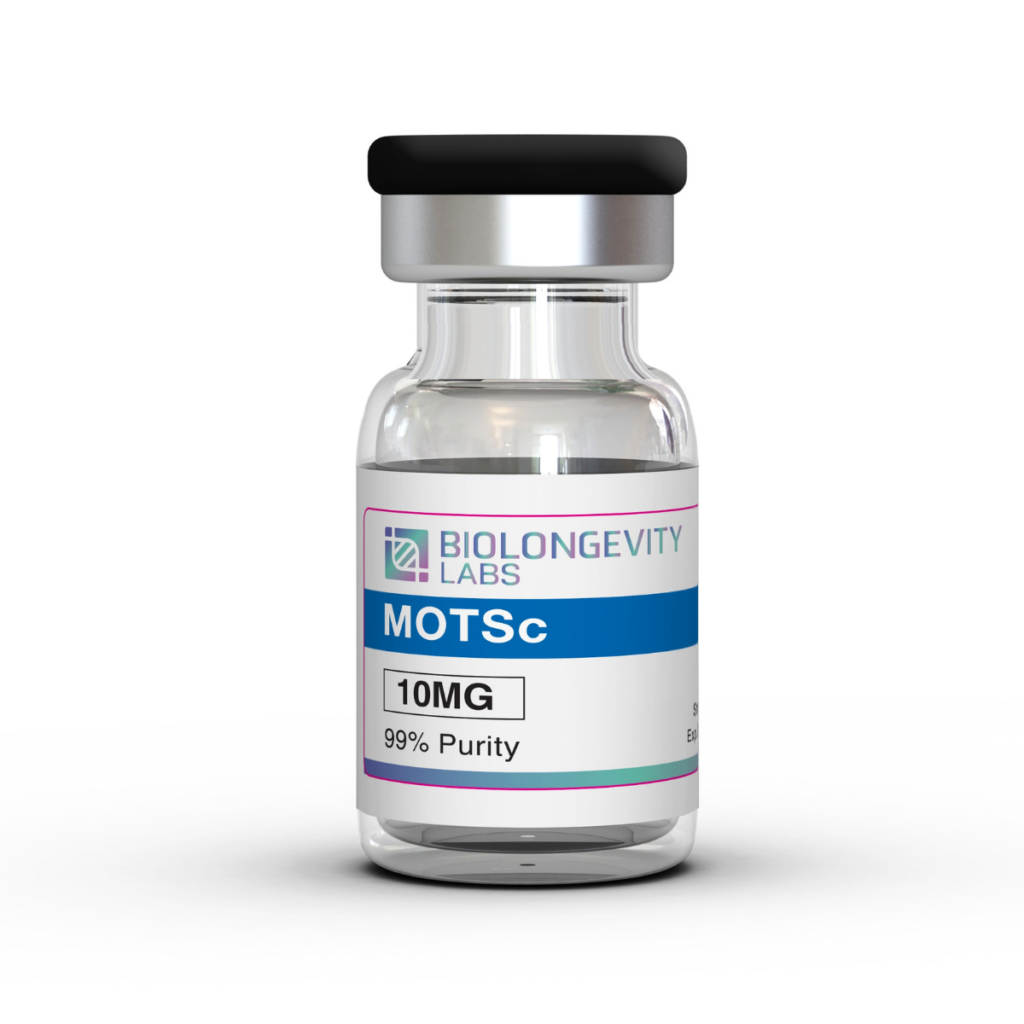
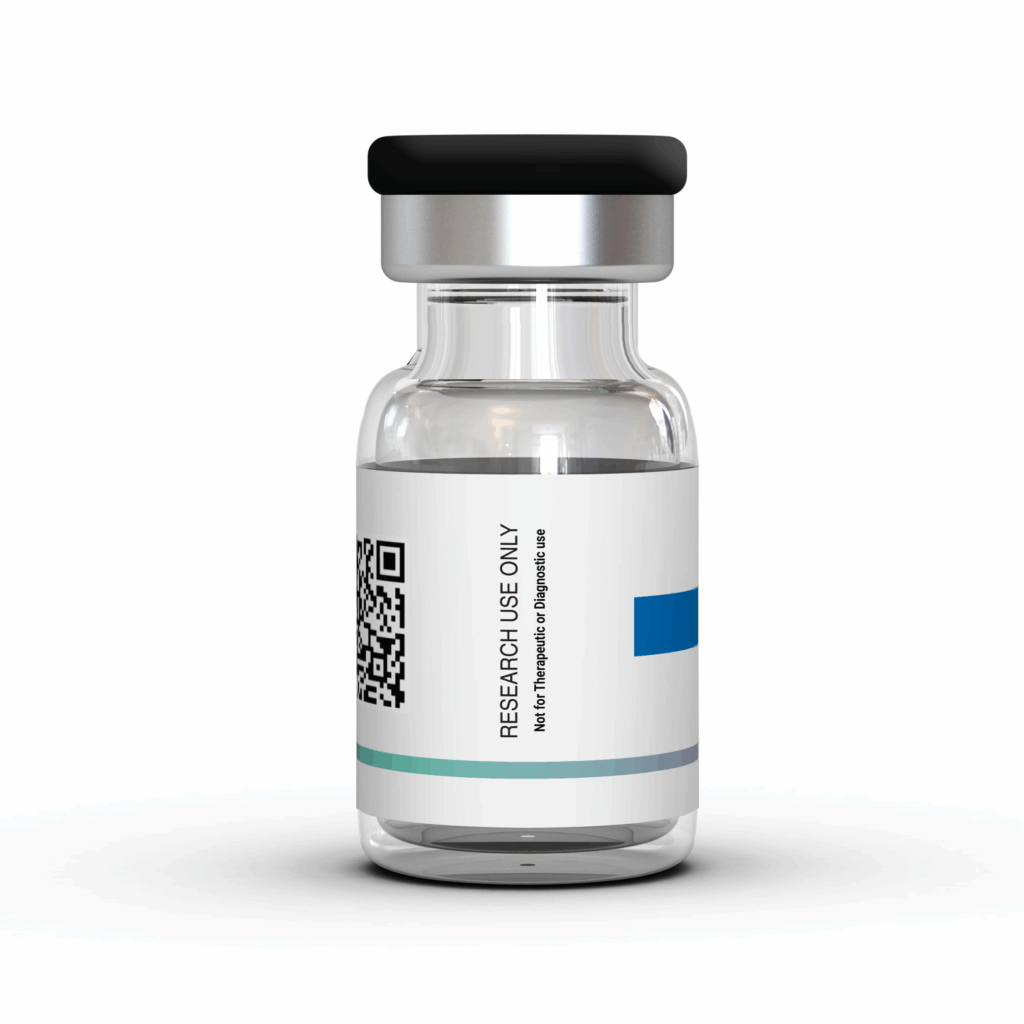
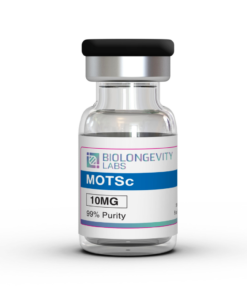
MOTS-c is a sixteen-residue mitochondrial-derived peptide encoded within the 12S rRNA region of the mitochondrial genome and produced here by solid-phase peptide synthesis. Each vial contains 10mg of lyophilized white powder with no fillers added. The compound is characterized in laboratory research examining AMPK signaling, one-carbon metabolism, and mitochondrial-to-nuclear communication. It is supplied at ≥99% purity (HPLC) and verified by third-party analysis for research use only.
MOTS-c Product Description
MOTS-c belongs to a small family of mitochondrial-derived peptides, short open reading frames encoded in mitochondrial DNA rather than the nuclear genome. It was first described in 2015 and its sequence, MRWQEMGYIFYPRKLR, has been the reference form used across the published literature since.
Its research profile is distinct from nuclear-encoded signaling peptides because the molecule is studied as a retrograde signal, meaning laboratory work examines how a mitochondrially encoded product acts on nuclear gene expression rather than the reverse. That positioning places MOTS-c alongside compounds such as SS-31 in mitochondrial research programs, though the two act through separate pathways.
The material supplied by BioLongevity Labs is manufactured in the United States and characterized for analytical and experimental evaluation under controlled laboratory conditions.
Compound Information
| Property | Value |
|---|---|
| CAS Number | 1627580-64-6 |
| PubChem CID | 176489569 |
| Molecular Formula | C₁₀₁H₁₅₂N₂₈O₂₂S₂ |
| Molecular Weight | 2174.6 g/mol (free base) |
| Amino Acid Sequence (One-Letter) | MRWQEMGYIFYPRKLR |
| Amino Acid Sequence (Three-Letter) | H-Met-Arg-Trp-Gln-Glu-Met-Gly-Tyr-Ile-Phe-Tyr-Pro-Arg-Lys-Leu-Arg-OH |
| Sequence Length | 16 residues |
| Source | Synthetic (solid-phase peptide synthesis) |
| Purity | ≥99% (HPLC) |
| Appearance | Lyophilized white powder |
| Solubility | Soluble in water; soluble in DMSO |
| Storage | -20°C, protect from light |
| Vial Size | 10 mg |
Storage and Handling
- Store the lyophilized compound at -20°C, protected from light and moisture.
- After reconstitution, store at 2°C to 8°C and use promptly; for extended holds, aliquot and store at -20°C to avoid repeated freeze-thaw cycles.
- Maintain aseptic handling and use sterile reconstitution solvent to preserve compound integrity.
Lyophilized Format
This compound ships in lyophilized (freeze-dried) form. Freeze-drying supports long-term storage stability and preserves compound integrity. No fillers are added.
Research Use Disclaimer
Tesamorelin is supplied for research use only. It is not a drug, food, cosmetic, or dietary supplement, has not been evaluated by the FDA, and is for research use only. By purchasing, the buyer confirms the compound will be used solely for in vitro research.
MOTS-c Research
The compound was first characterized in 2015, where it was reported to act on the folate–methionine cycle and downstream one-carbon metabolism, with accumulation of the purine intermediate AICAR and subsequent AMPK activation observed in cell and rodent models [1]. That AMPK-linked mechanism has anchored most subsequent laboratory work.
A 2018 study reported that MOTS-c translocates from the cytosol to the nucleus under metabolic stress and interacts with stress-responsive transcription factors including NFE2L2/NRF2 at antioxidant response elements [2]. This is the basis for describing the molecule as a mitochondrial-to-nuclear signal rather than a purely cytosolic one. Work on glucose transporter handling has been examined alongside it, with one study reporting that OPA1 and MFN2 mediated mitochondrial fusion was required for MOTS-c associated GLUT4 translocation in cultured mammalian cell and adipocyte models [3]. Researchers comparing mitochondrial-targeted compounds may find the SS-31 and MOTS-c comparison guide useful context, as is the overview of how NAD+ differs structurally from peptides.
The research threads below cover the two areas where published data is most developed.
Kinase Binding and Skeletal Muscle Signaling
A 2024 cell-free binding study reported that MOTS-c binds directly to protein kinase CK2 and activates it, with tissue-differential activity observed between skeletal muscle and adipose tissue [4]. An earlier report described a CK2 to PTEN to mTORC2 to AKT to FOXO1 cascade associated with reduced myostatin expression in C2C12 myotubes exposed to palmitic acid [5].
Myogenic Differentiation Models
In vitro work in LHCN-M2 and C2C12 myoblast lines reported increased myotube formation following exposure to wild-type MOTS-c, an outcome not observed with the Y8F mutant variant, which points to a defined sequence region as the active site [6].
Exercise-responsive expression has also been examined in study populations and rodent models, where circulating levels were reported to change with physical activity and with age [7]. Broader reviews place MOTS-c within the wider mitochondrial-derived peptide family studied in aging research models [8].
| Research Area | In Vitro Application |
|---|---|
| Energy Metabolism | AMPK phosphorylation and AICAR accumulation assays in cultured cells |
| Mitochondrial Biology | Fusion marker assays (OPA1, MFN2) and biogenesis marker panels (TFAM, NRF1, COX4) |
| Nuclear Signaling | Nuclear translocation imaging and antioxidant response element reporter assays |
| Skeletal Muscle Research | Myotube differentiation assays in C2C12 and LHCN-M2 myoblast lines |
| Glucose Transport | GLUT4 translocation and glucose uptake assays in adipocyte models |
| Kinase Interaction | Cell-free CK2 binding and kinase activity assays |
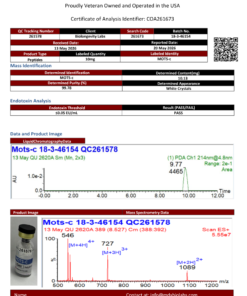
Certificate of Analysis (COA) for Every Batch
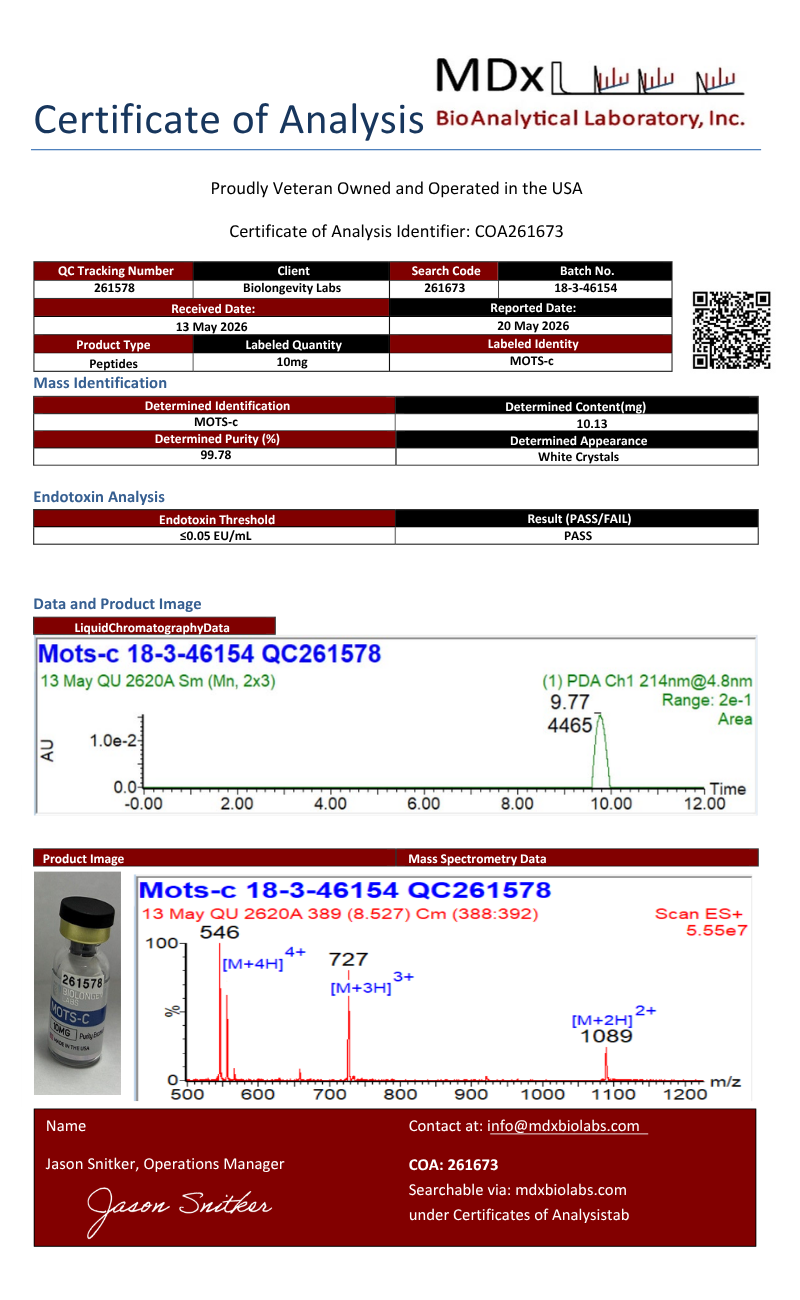
A Certificate of Analysis (COA) is a document that verifies a compound’s identity, purity, and batch quality through independent laboratory testing. Every compound from BioLongevity Labs ships with a COA tied to its specific batch, so researchers can confirm exactly what they received before it enters a protocol.
Each COA reports results from third-party laboratory analysis, including:
- High-performance liquid chromatography (HPLC) for purity, typically confirmed at 99% or higher
- Liquid chromatography mass spectrometry (LC-MS) for molecular identity and mass confirmation
- Sterility and endotoxin screening where applicable
- Chemical contaminant and residual solvent checks
COAs are sourced from independent certified labs rather than in-house testing alone, giving researchers a verifiable record of molecular integrity for each batch. All compounds are supplied for research use only.


Reviews
There are no reviews yet.